The Kenbak-1
years old
The world’s first commercially available personal computer
Built in spring 1971. At the dawn of the computer age. Inspiration for many engineers and developers.
Mission statement
This website is dedicated to the world’s first commercially available personal computer and the only existing prototype. This website has no ads, does not use cookies, does not track you and is hosted in the European Union.
Kenbak-1 Registry
After taking care of John Blankenbaker's former webpage to preserve his legacy and the history of the Kenbak-1, I decided to create a registry of the Kenbak-1. Someone should preserve this history and follow the path of the few original Kenbak-1 computers.
I also maintain the Apple-1 Registry. It requires more effort and work than one might imagine. But the result is worth it.
Visit the Kenbak-1 Registry.
The direct contact and many conversations make me feel very connected to John. It was a twist of fate that he was ahead of his time. He even planned a successor with a CPU. But since the computer was only advertised in Scientific American, the commercial success was low. Who knows, maybe otherwise we would have been working with a 'Kenbak-X'?
John Blankenbaker's former website kenbak-1.net
John Blankenbaker was 92 years old when he stopped maintaining his website. The website was down. I had been in contact with him for years, visited him twice and finally he gave me permission to rescue the website and keep his legacy alive.
John wrote to me on March 4, 2022, "Yes you may have the content. I used a .net designation. Perhaps you might want to convert to a .com or a .info designation."
John Blankenbaker's original kenbak-1.net website.
Note: His website is very old and static, not suitable for mobile devices. Changes were made very carefully to preserve the original state as well as possible.
About the Kenbak-1
The Kenbak-1 was a commercially available computer from 1971, years before the Altair, IMSAI, Apple etc. appeared.
The inventor was John V. Blankenbaker from California. It was created before any microprocessor was available. In 1971, shortly after creating the prototype, John looked at the first microprocessor, but it could not improve the design.
The idea to build the Kenbak-1 was born in fall of 1970. By spring 1971 John Blankenbaker had built the prototype all by himself, from scratch.
The computer is very educational and John wanted to sell the Kenbak-1 mainly to schools.
Judged the "first commercially available personal computer" in 1986 by a panel at the Boston Computer Museum (later the Computer History Museum San Jose) that included Apple co-founder Steve Wozniak. Published in the Computer Museum Report, Volume 17, Fall 1986.
This makes the prototype Kenbak-1 the first of the first personal computers. A very emotional discussion goes on about the question of the first personal computer. The problem is that ‘personal computer’ is not exactly defined. And many other computers were nominated by different people to be the first personal computer.
The Kenbak-1 is considered by the American Computer Museum to be the world’s "first personal computer”.
But anyway, it was the Kenbak-1 that was chosen by experts including Steve Wozniak. It was a remarkable step towards the computer revolution. The real computer revolution was not beginning with mainframes etc. used for business. The private use of computers started it all.
The American Computer Museum calls it the world's "first commercially available personal computer". The Altair 8800 was later called the “first commercially successful personal computer”. A very good compromise. Later, other computers received different titles.
John V. Blankenbaker was one of the early computer entrepreneurs who started and worked in a garage. He designed the computer and all manuals etc. by himself.
The name Kenbak was obviously chosen from his last name Blankenbaker. Here is the story.
The Kenbak-1 was unfortunately sold only about 40 units. The personal computer revolution started years later. The story of the Kenbak-1 is one of those tragic stories in history. The company couldn’t afford to place more ads, for example in Popular Electronics. And so, the company was slowly running out of money.
Later the company was sold and the successor, CTI Education Products Inc., received building material for many Kenbak-1 units. This company sold only a few Kenbak-1 computers under the name H-5050.
This company never paid John Blankenbaker and eventually sent him back parts for some 45 Kenbak-1 computers as some kind of payment.
John advertised the computer only in the Scientific American magazine from September 1971 for two or three issues. Probably focusing on private individuals and advertising in the Popular Electronics magazine would have resulted in a much bigger success. Like it was for the Altair 8800 in 1975.
Today, only a few original Kenbak-1 still exist. Only 14 machines are believed to exist worldwide. Revision A and B boards exist. And only one prototype was ever built. If the Kenbak-1 is considered the first commercially available personal computer, then the prototype is the very first ever.
Technical data
256-byte serial memory (two MOS shift registers, each 1,024 bits) and 1 MHz clock speed, 132 ICs. Programming is done in machine language.
Differences between the prototype and the production units
 The Kenbak-1 was never breadboarded or tested prior to the design of the mainboard. Remarkably John's design had only a few errors and just a few additional wires and other minor changes were required.
Only the prototype has a red enter button. This was changed for the production units and an additional switch was installed to protect against changing the program status.
The production units have a slot in the front for a possible punched card reader which was never available. The legends below the switches were relocated for better reading.
Just a few changes in the design of the motherboard for the production units were necessary. The prototype has some hand-soldered additional components.
The case was colored by John Blankenbaker himself. He gave a sample of the color to the company that produced the production unit cases. For this reason, the color on the prototype is not consistent and scratches are more common.
The prototype has no serial number or labels. The production units started with serial number 167. John lived 12167 Leven Lane, Los Angeles.
The only existing Kenbak-1 prototype
The first of the first personal computer.
 I had always been fascinated by the Kenbak-1. Very rarely this unique computer from 1971 is available for purchase. John Blankenbaker created this computer from scratch by himself. Later it was sold in small numbers.
I called John Blankenbaker and asked him if he still owned a Kenbak-1. And yes, he still had his one and only prototype of the Kenbak-1. It could hardly be more unique. His granddaughter was playing with it when I called him. Unfortunately, he had given it to an auction house just some weeks before I called him.
My final bid was not high enough and for technical reasons I had no chance to bid more.
Just by chance I had contact to the new owner of the Kenbak-1 in 2018. After some discussions, we had a deal. Probably only 15 Kenbak-1 still exist. And only one prototype.
From my point of view the fact that it is the only prototype and the very first was highly underestimated and I was more than surprised to get the chance to buy it.
The last owner of the Kenbak-1 prototype is a very friendly and interesting man from California. He has his own business and also works for the Computer History Museum. We spent a day talking.
After picking up the Kenbak-1 in a small town close to San Francisco (California) I visited John Blankenbaker and his wife in Vermont. They invited me to stay at their home. Both are such friendly people.
John plugged the Kenbak-1 into the wall socket before I could say, ‘Wait, shouldn’t we check the components first?’ He switched it on and started to program it. The Kenbak-1 instantly worked and I got it on video!
Amazingly, John was 88 years old when he entered the program in his prototype. It was 48 years after he built the prototype.
Eventually John signed the prototype for me. We talked almost two days about the early computer days.
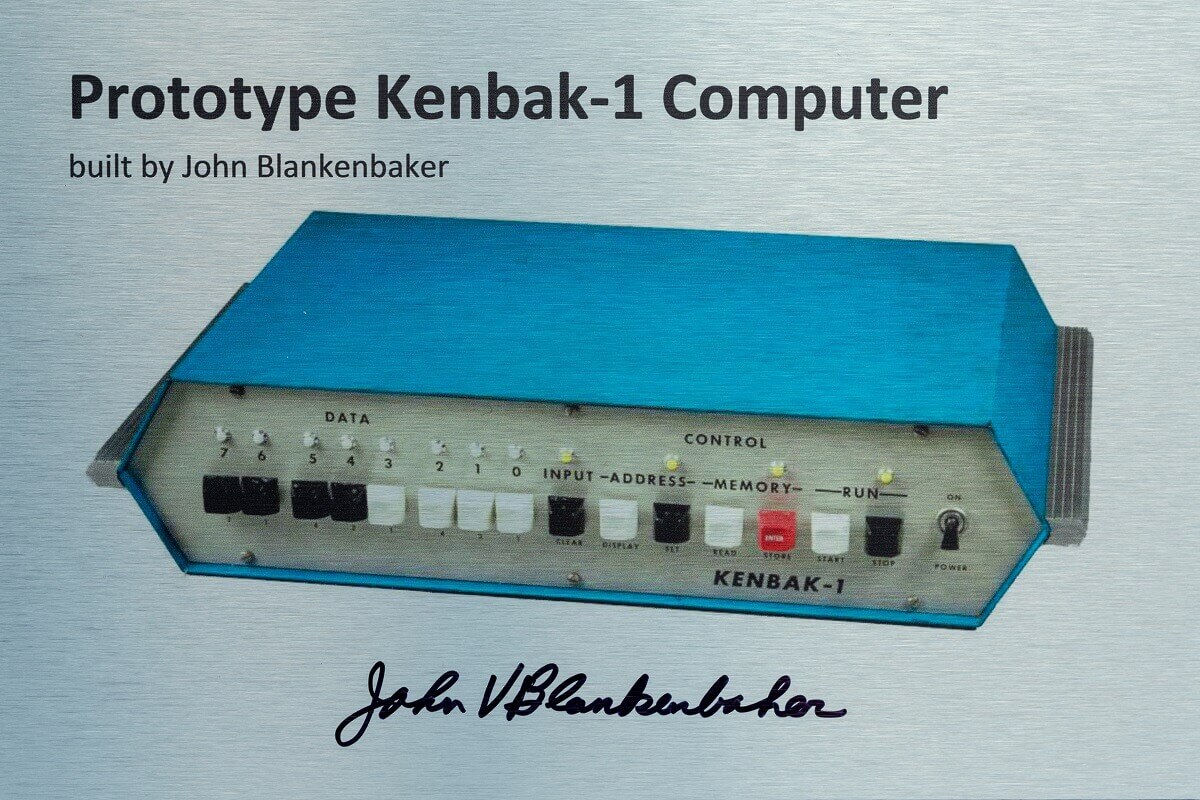
I gave John various glass and metal signs (one with a little dedication) as mementos and presents (see pictures) to honor his work.
In 2019 I visited John and his wife again. We had lunch and talked a lot. Finally, John lent me his bare PCB board which I took back to Germany.
Still existing Kenbak-1 computers
See the Kenbak-1 Registry.
Pictures
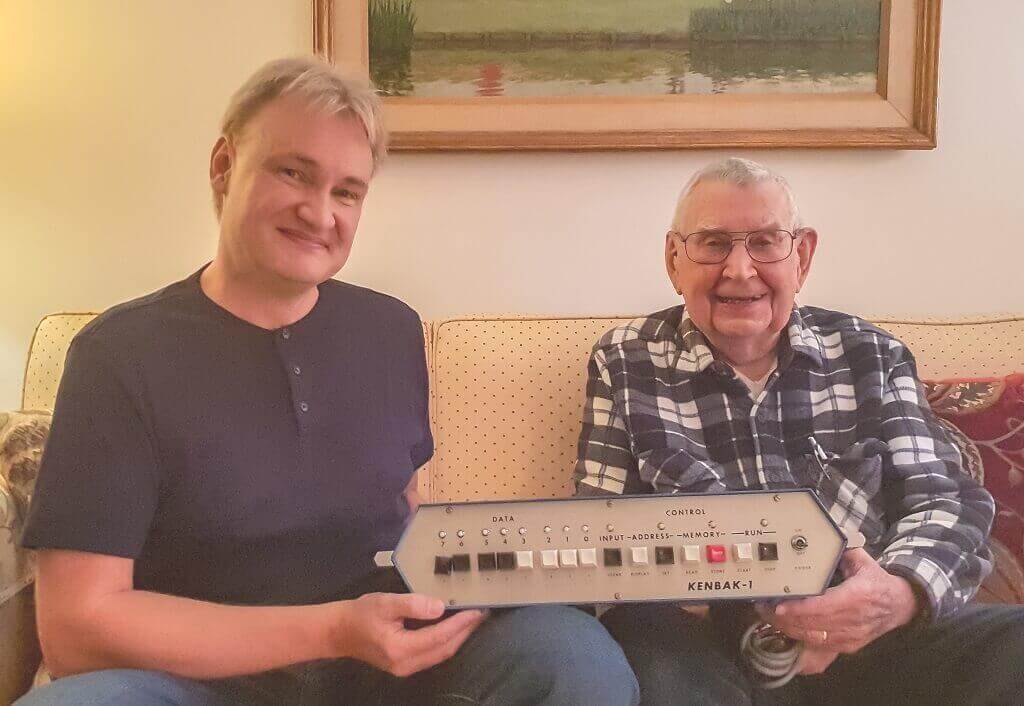 +
John Blankenbaker and Achim Baqué with signed prototype
+
John Blankenbaker and Achim Baqué with signed prototype
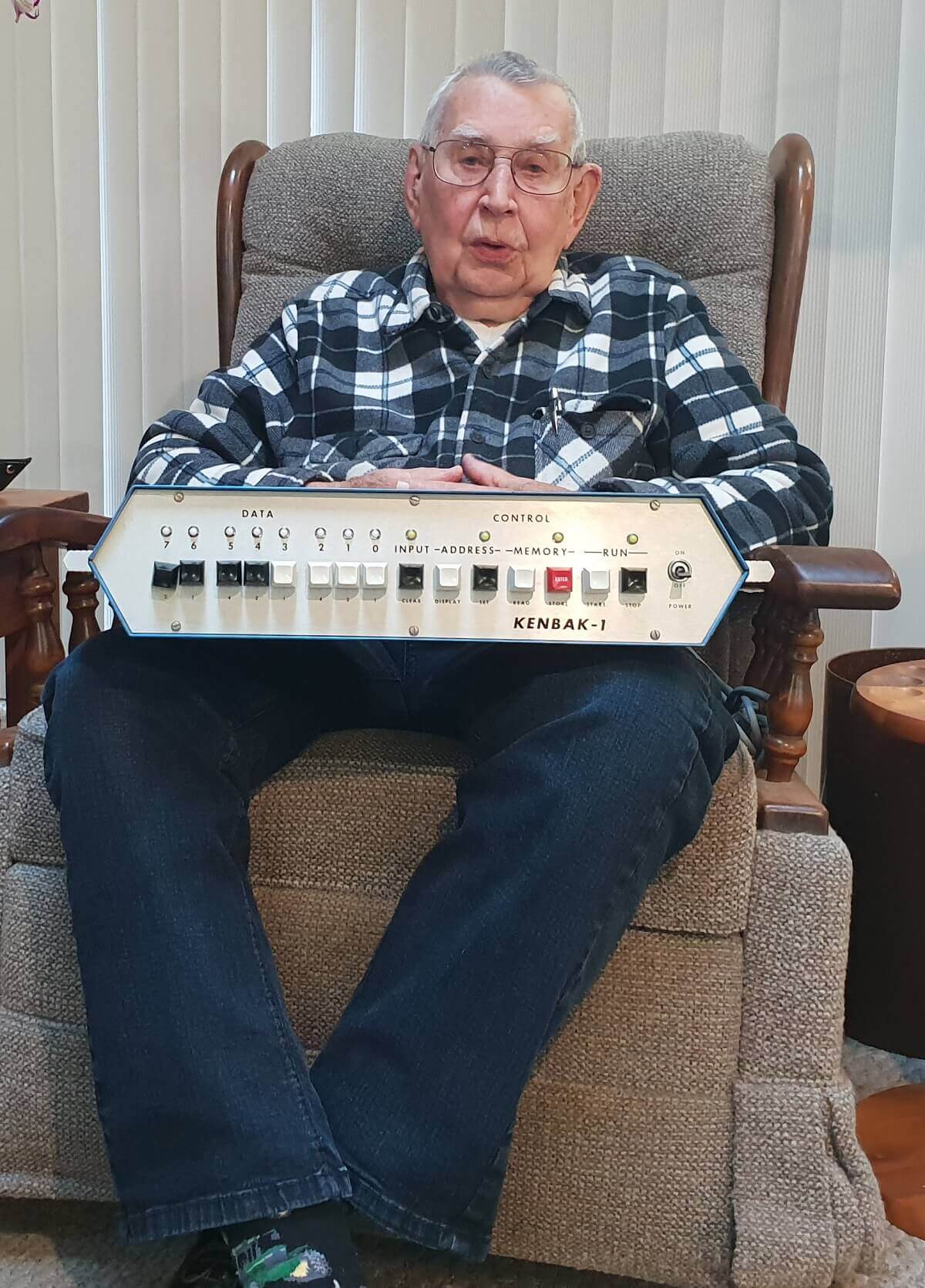 +
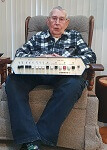
John Blankenbaker with signed prototype
+
John Blankenbaker with signed prototype
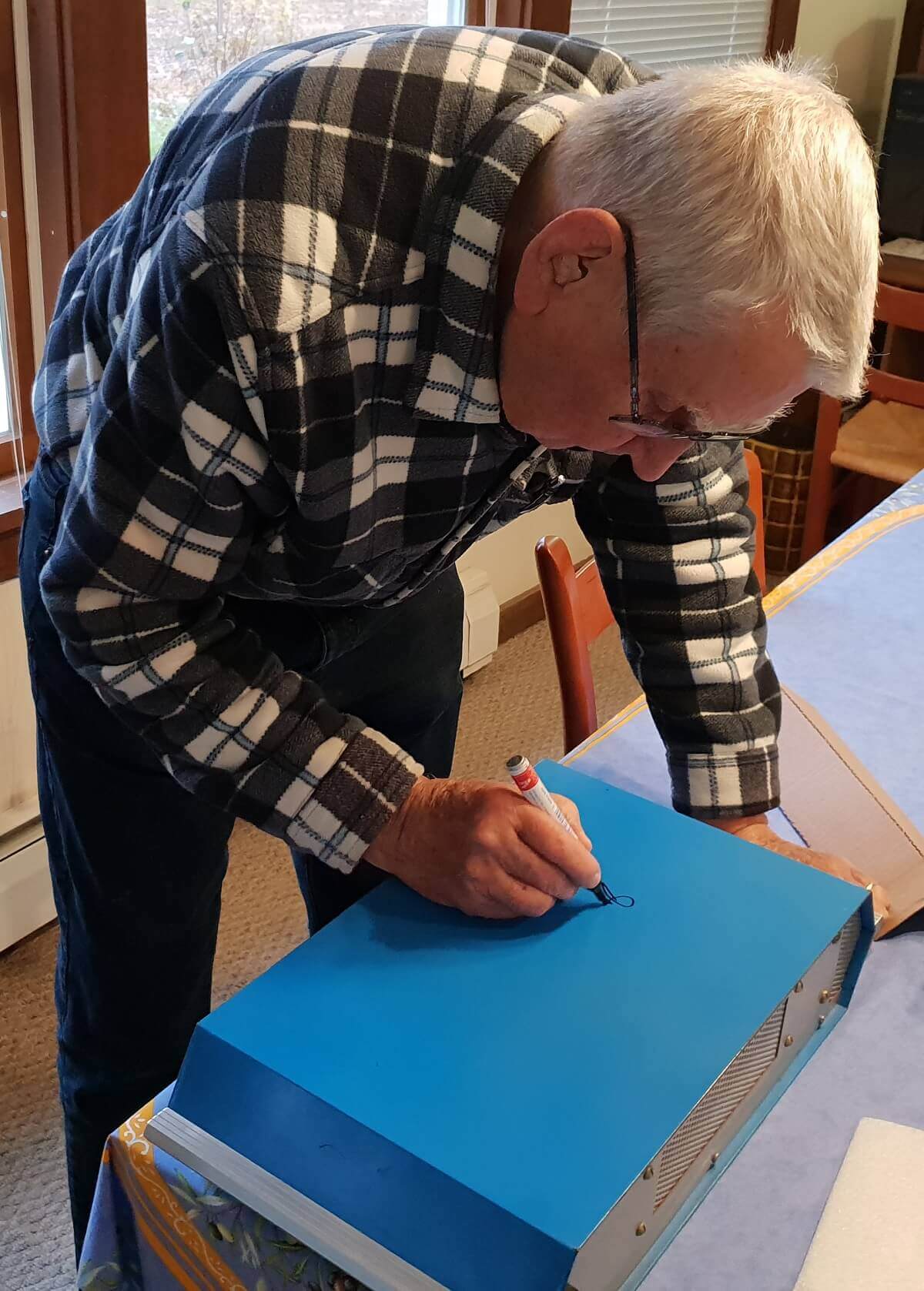 +
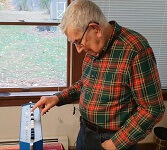
John Blankenbaker signing the prototype
+
John Blankenbaker signing the prototype
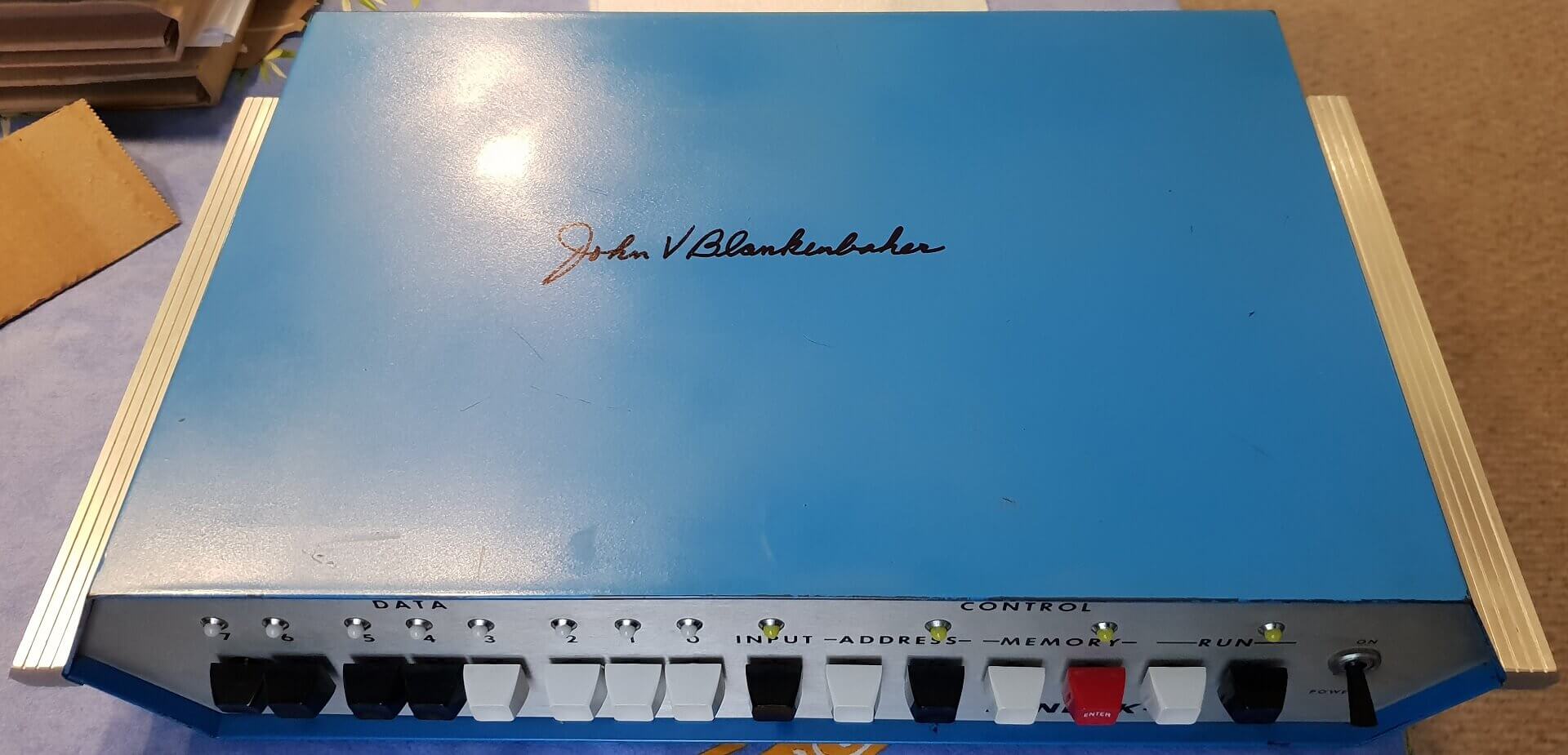 +
Shortly after signing
+
Shortly after signing
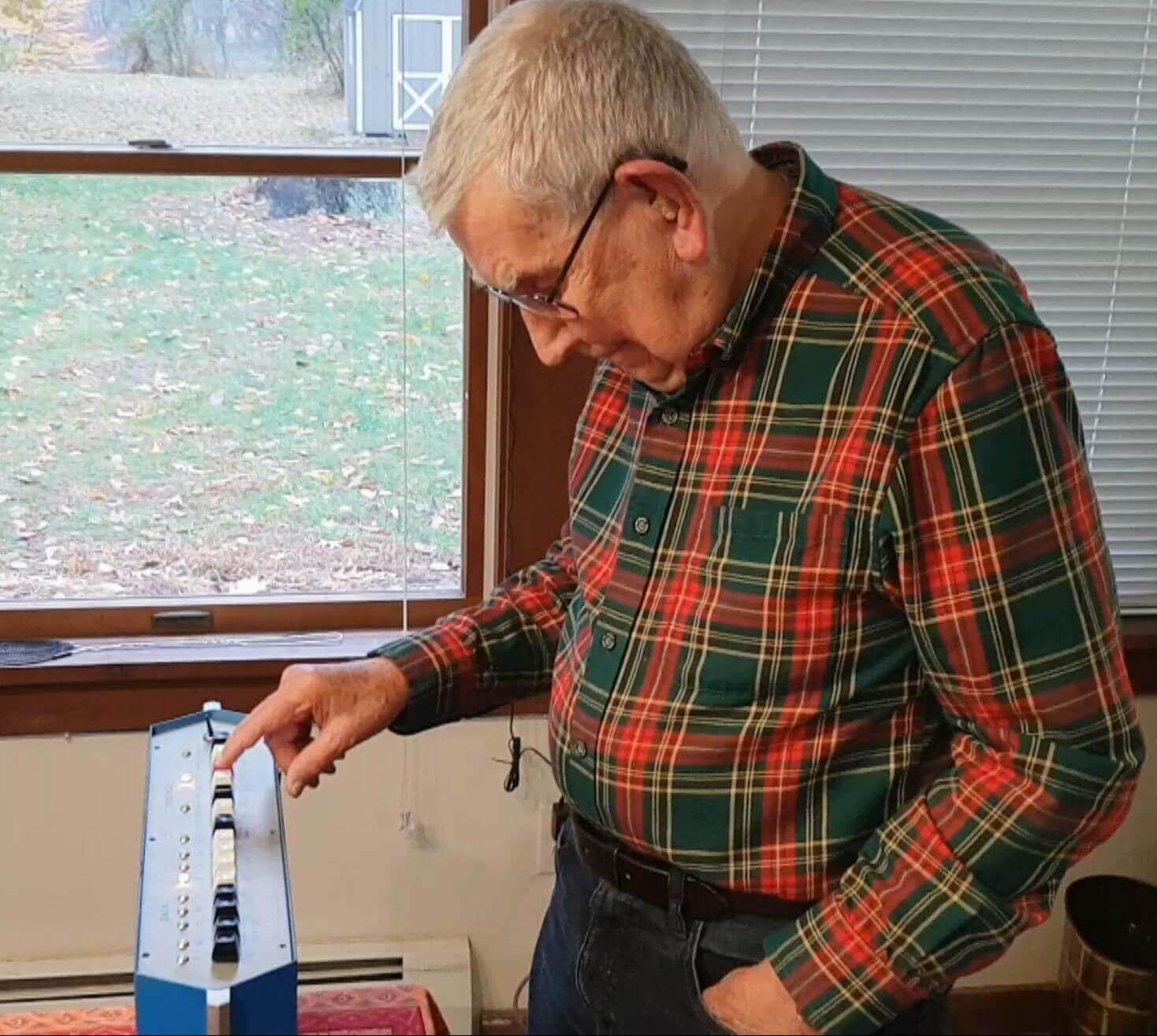 +
John enters a program in the prototype
+
John enters a program in the prototype
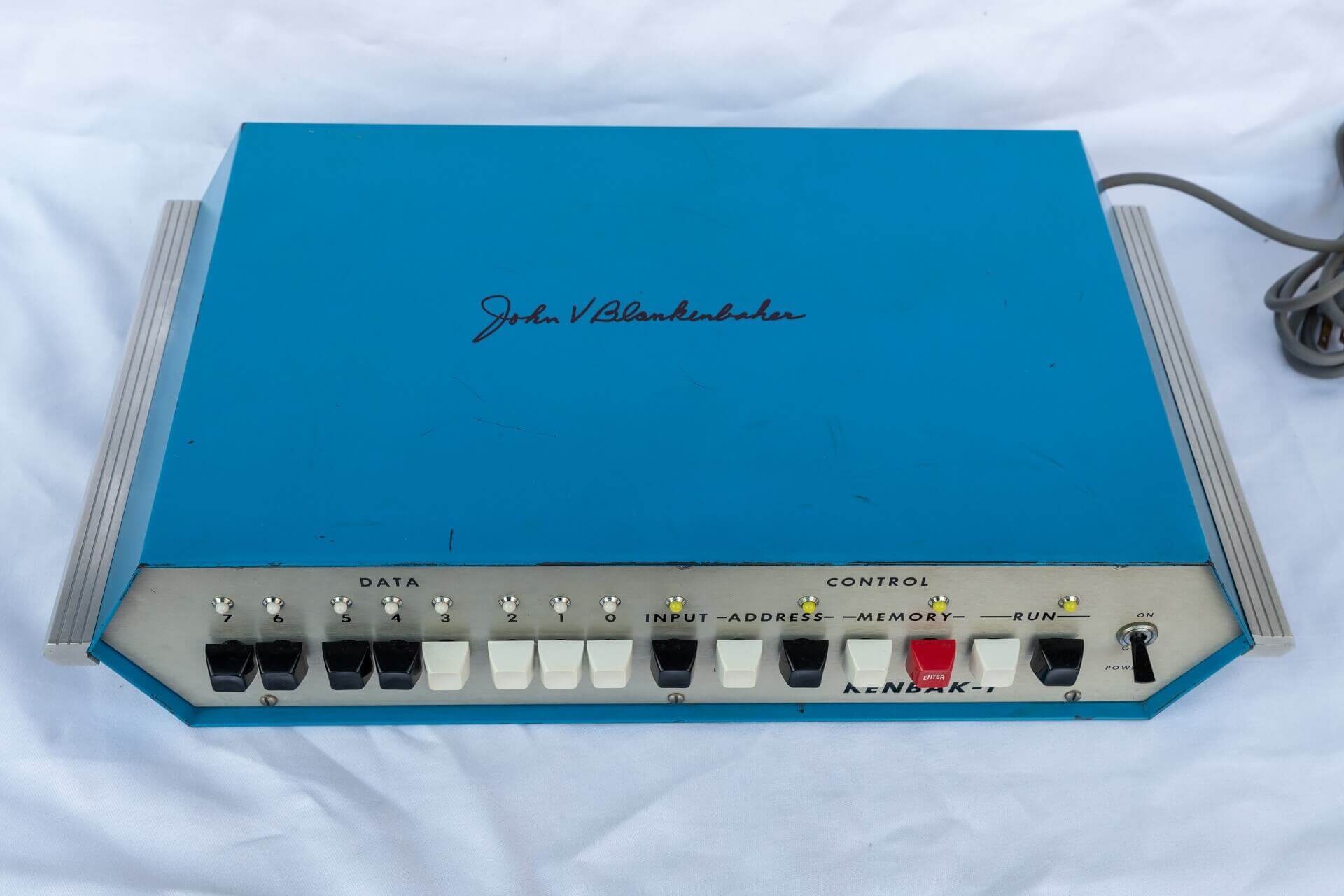 +
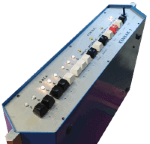
Kenbak-1
+
Kenbak-1
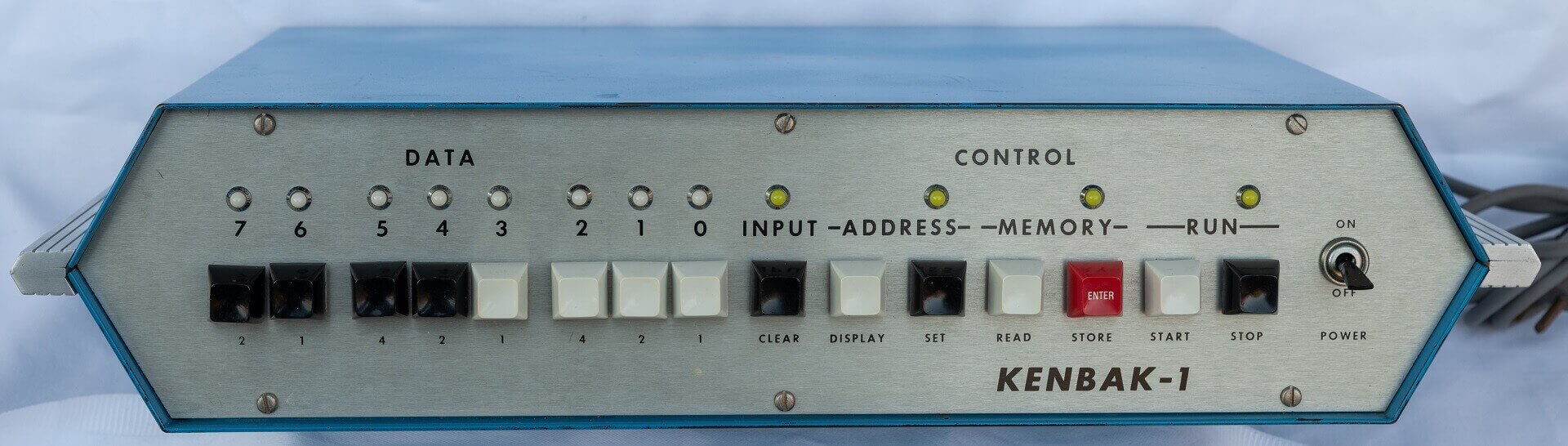 +
Kenbak-1
+
Kenbak-1
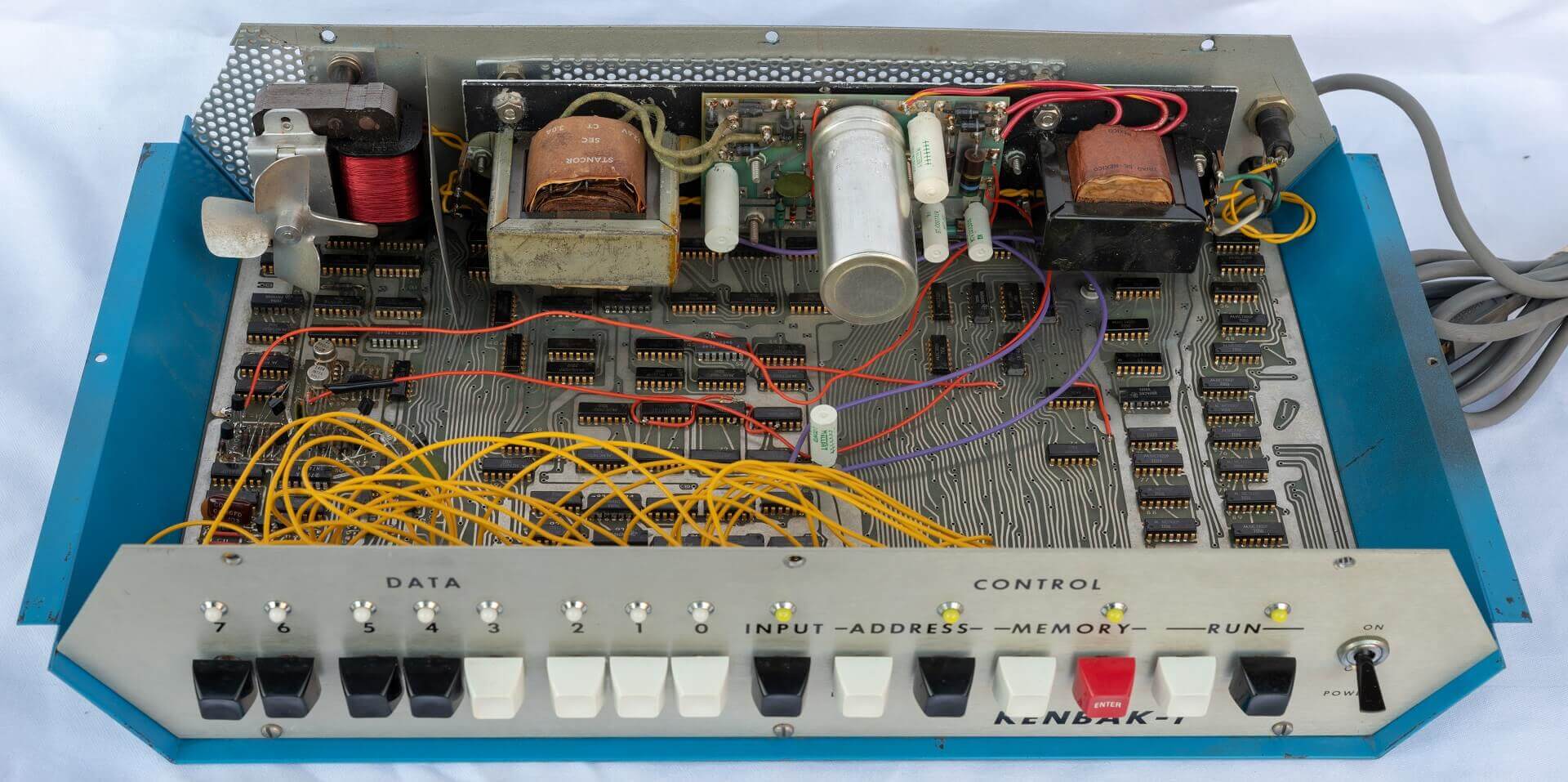 +
Kenbak-1
+
Kenbak-1
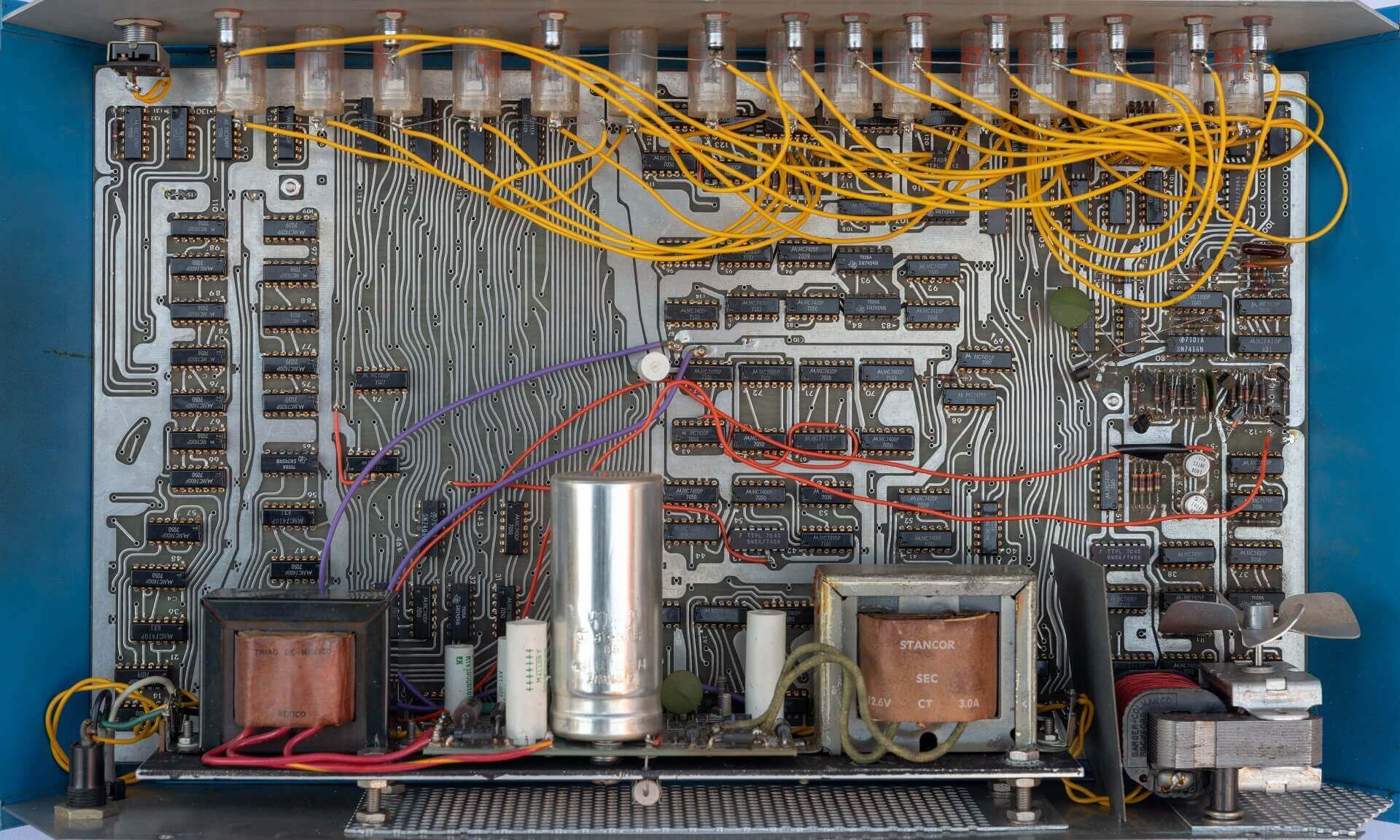 +
Kenbak-1 inside
+
Kenbak-1 inside
 +
Kenbak-1 mainboard
+
Kenbak-1 mainboard
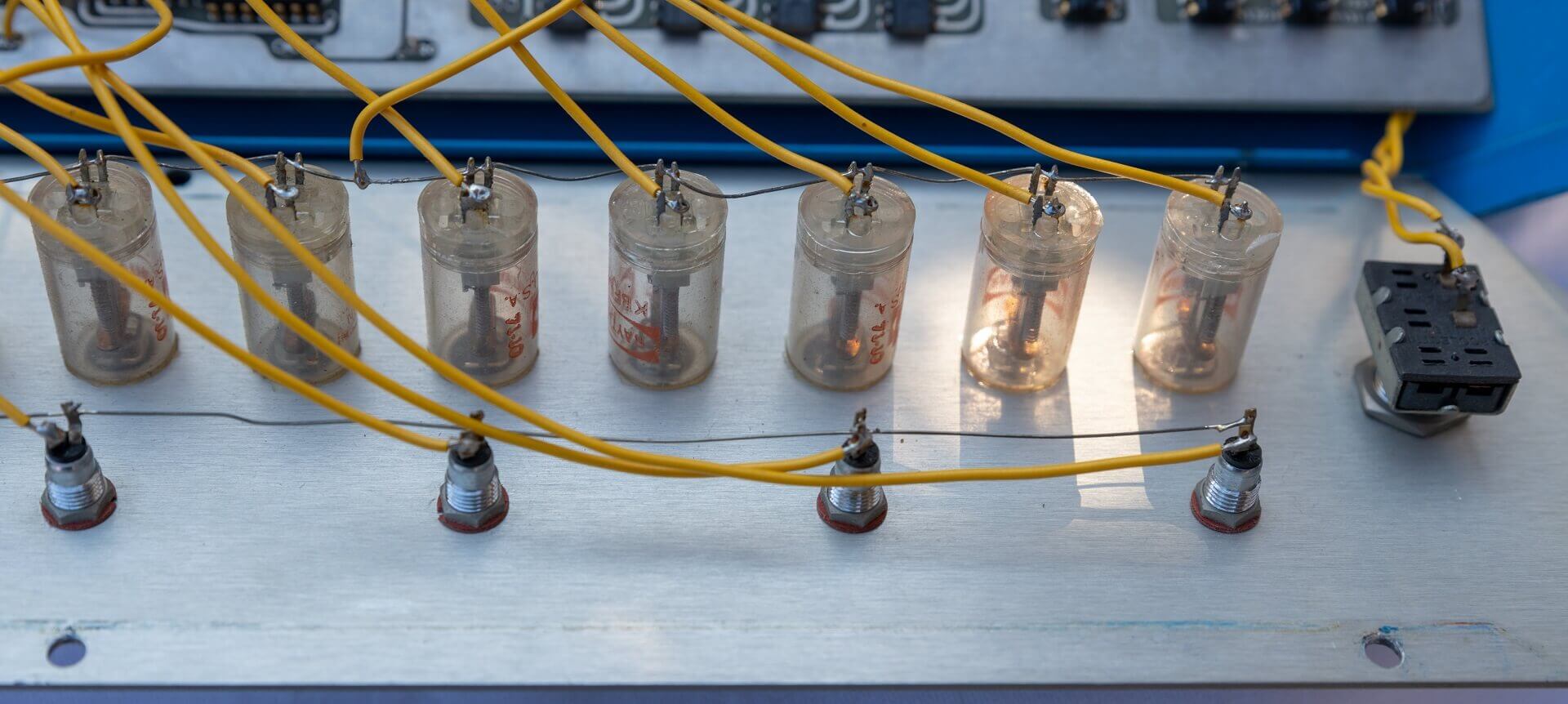 +
Switches
+
Switches
 +
Power Supply
+
Power Supply
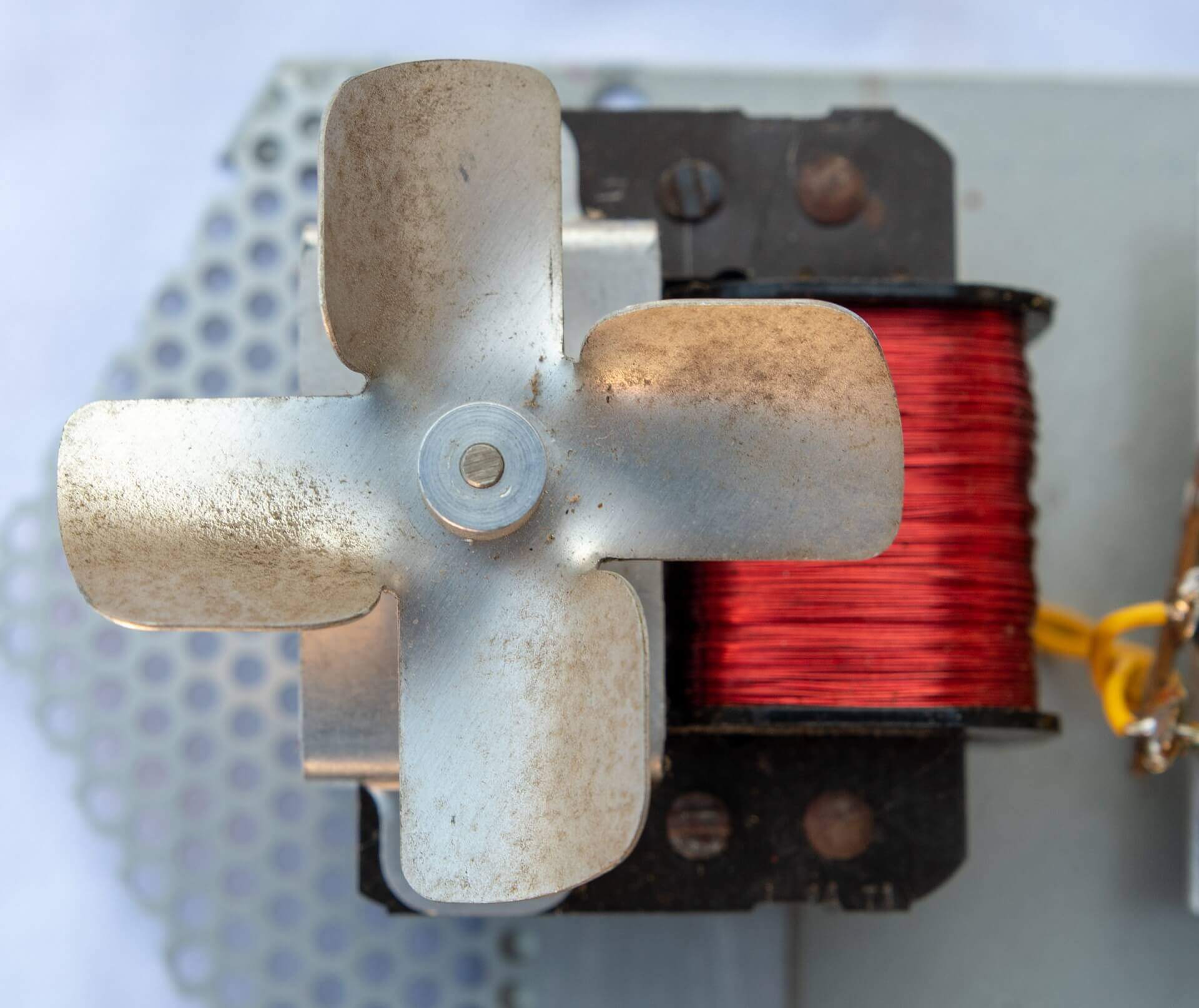 +
Fan
+
Fan
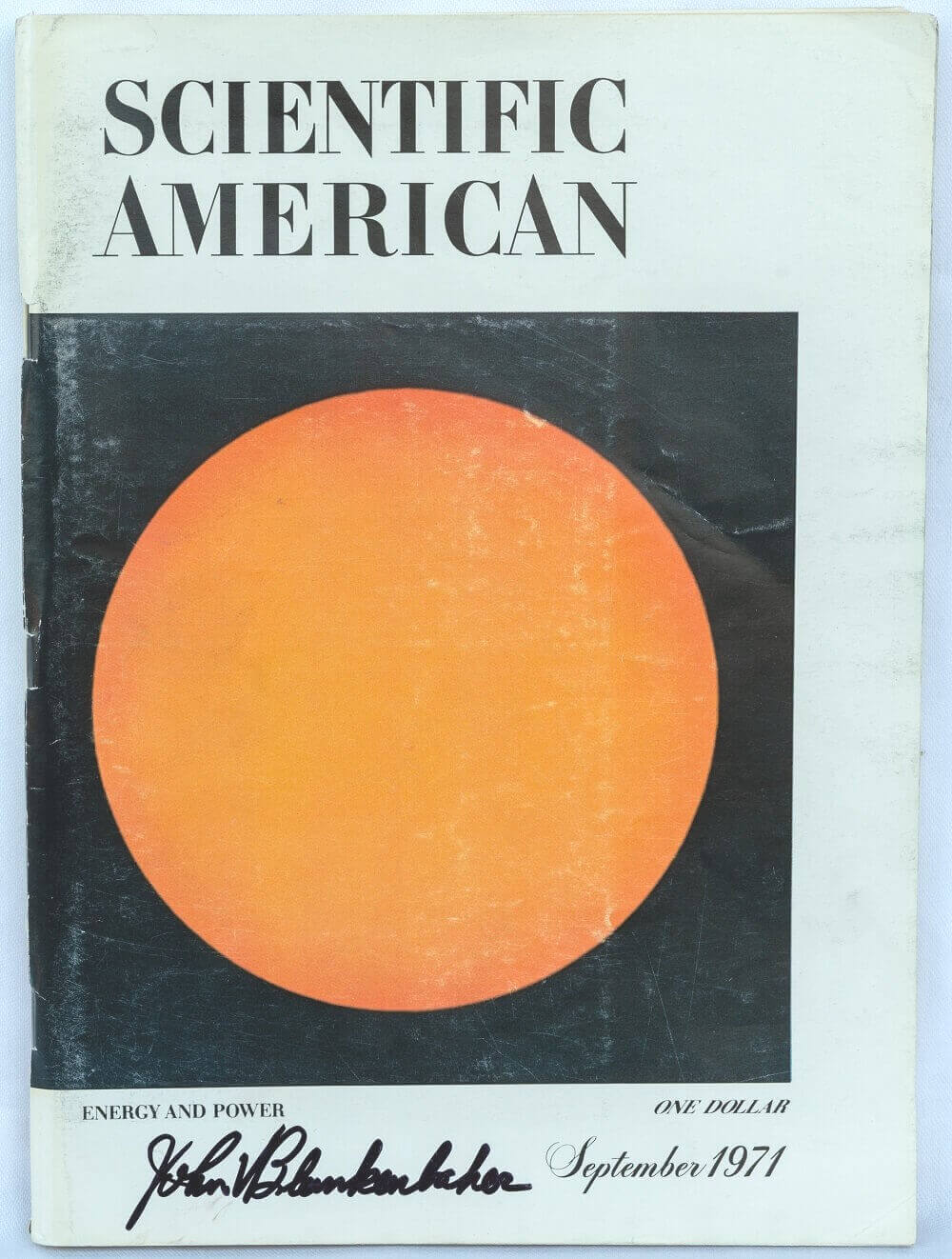 +
Signed Scientific American with Kenbak-1 ad
+
Signed Scientific American with Kenbak-1 ad
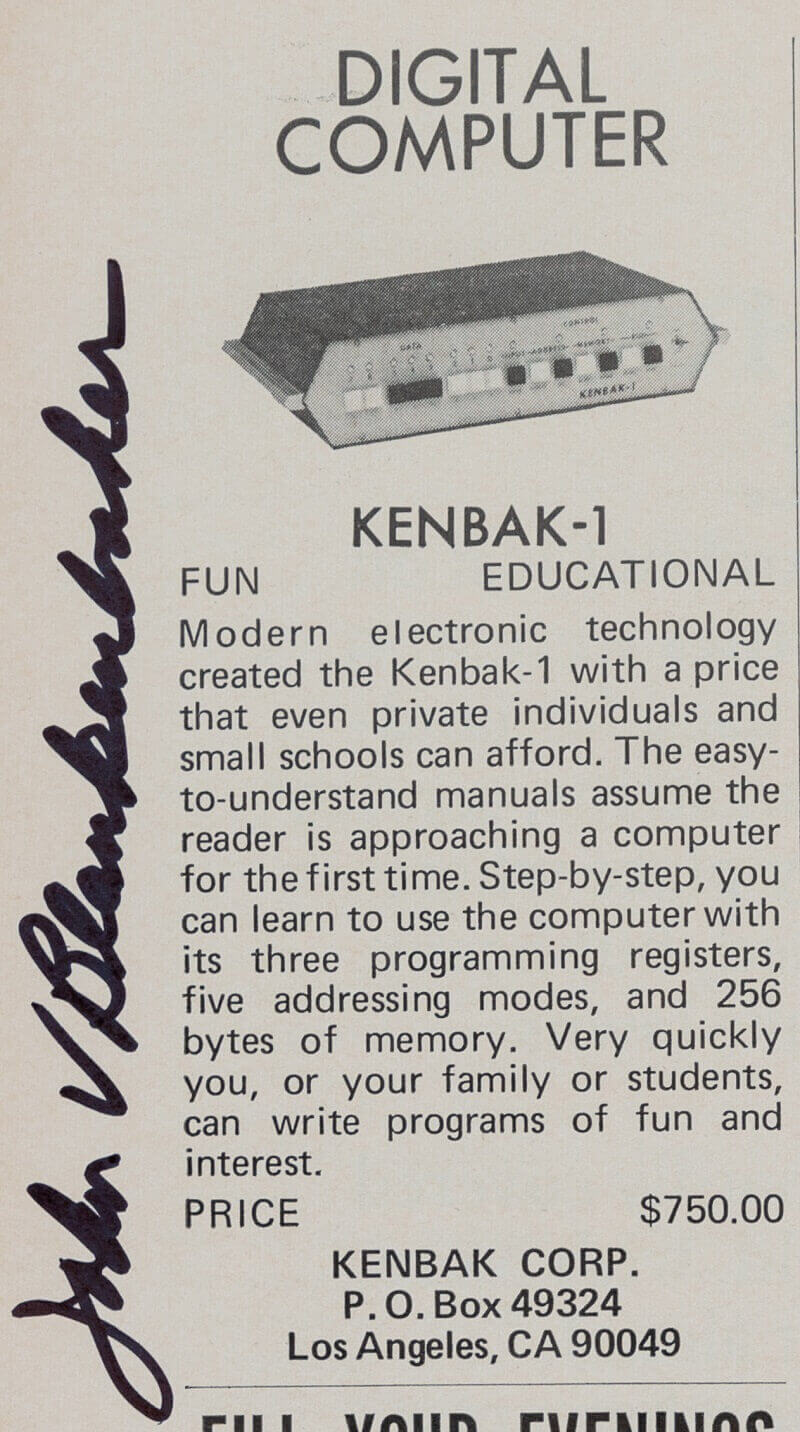 +
Signed Kenbak-1 ad
+
Signed Kenbak-1 ad
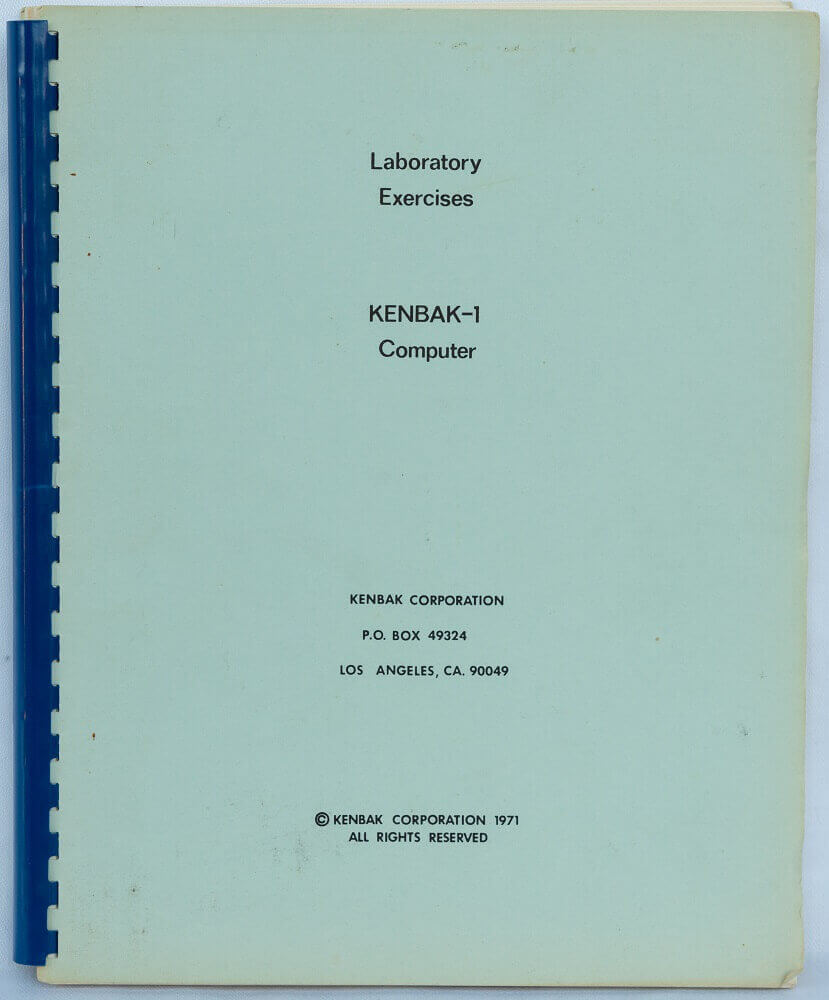 +
Manual
+
Manual
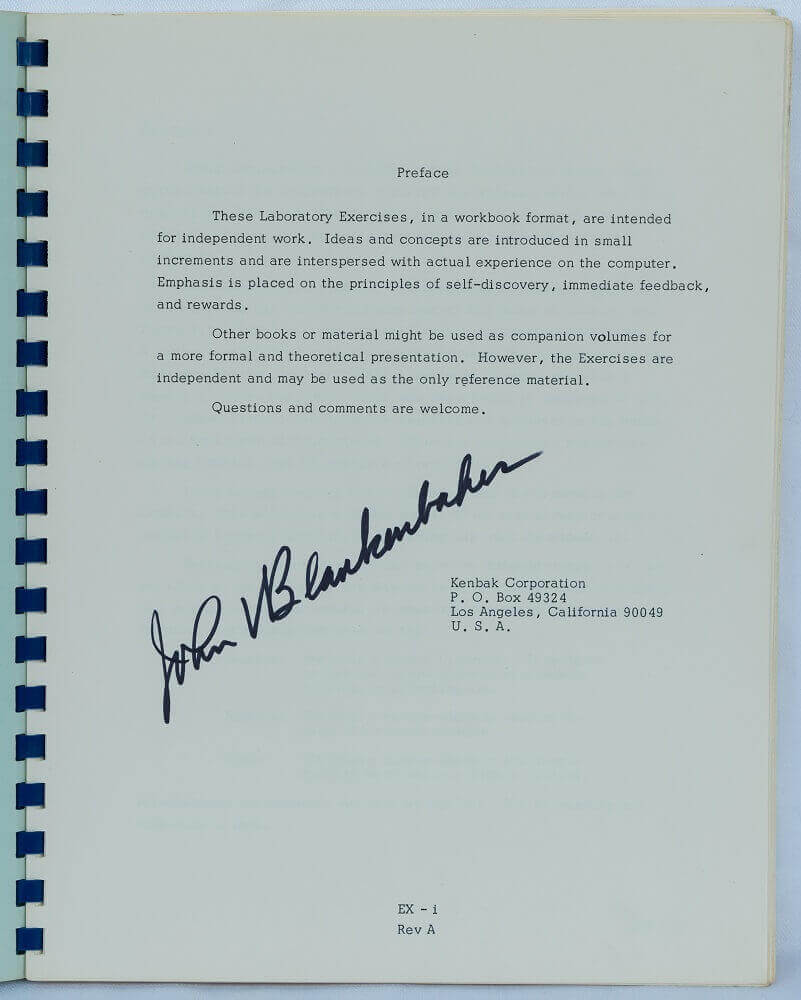 +
Manual signed by John Blankenbaker
+
Manual signed by John Blankenbaker
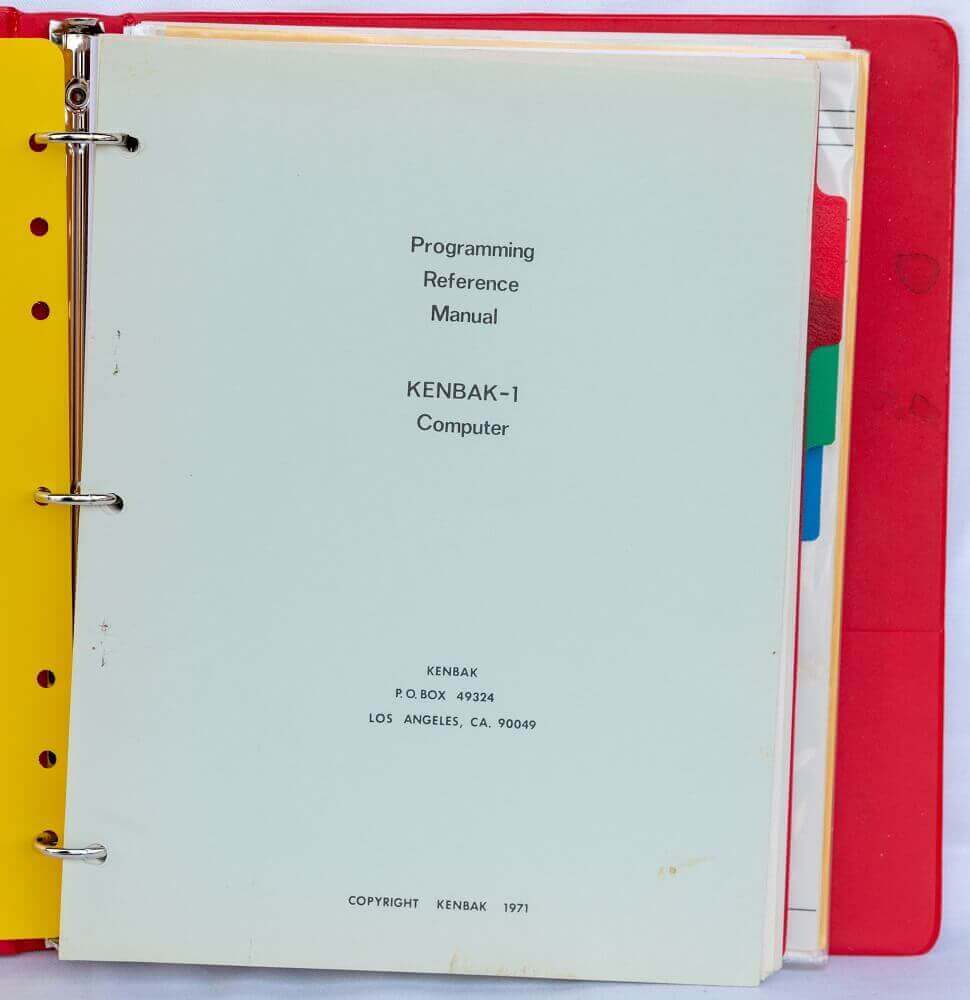 +
Manual
+
Manual
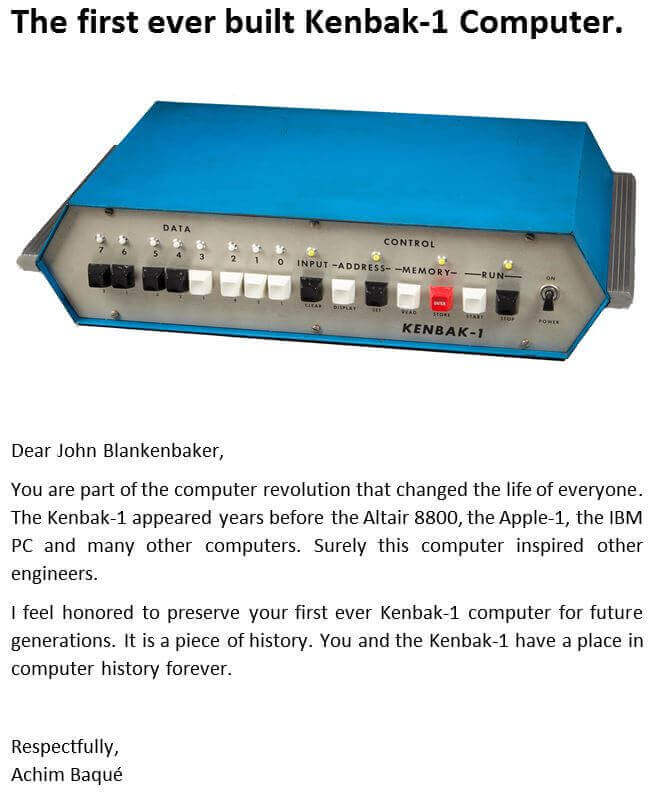 +
Dedication for John Blankenbaker
+
Dedication for John Blankenbaker
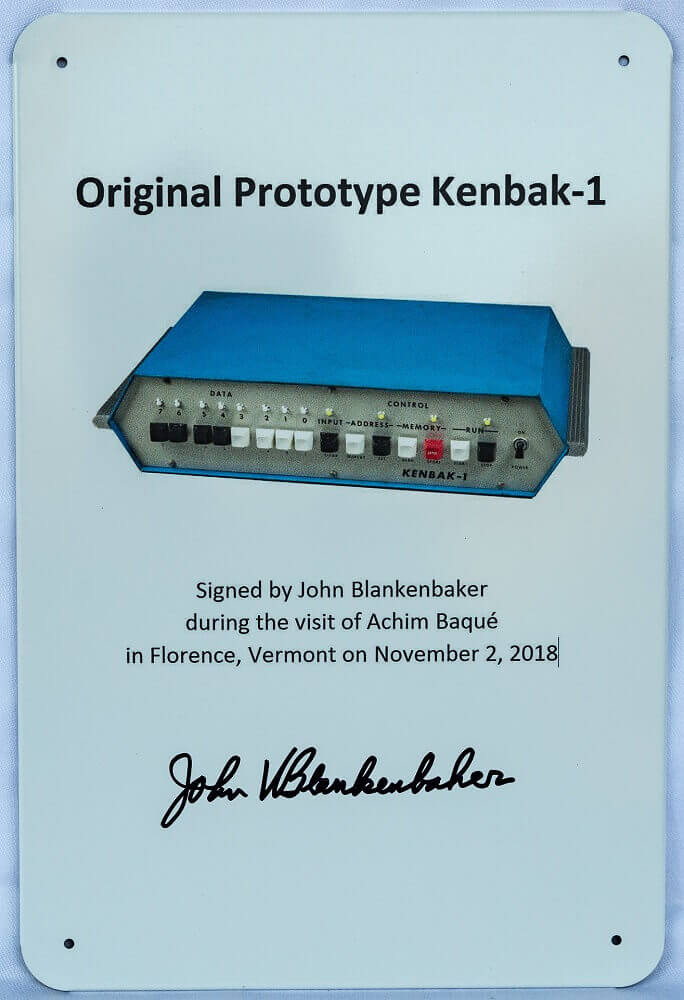 +
Signed by John Blankenbaker
+
Signed by John Blankenbaker
 +
Signed by John Blankenbaker
+
Signed by John Blankenbaker
 +
Signed by John Blankenbaker
+
Signed by John Blankenbaker
 +
Signed by Jeremy Norman
+
Signed by Jeremy Norman
 +
Signed by John Blankenbaker
+
Signed by John Blankenbaker
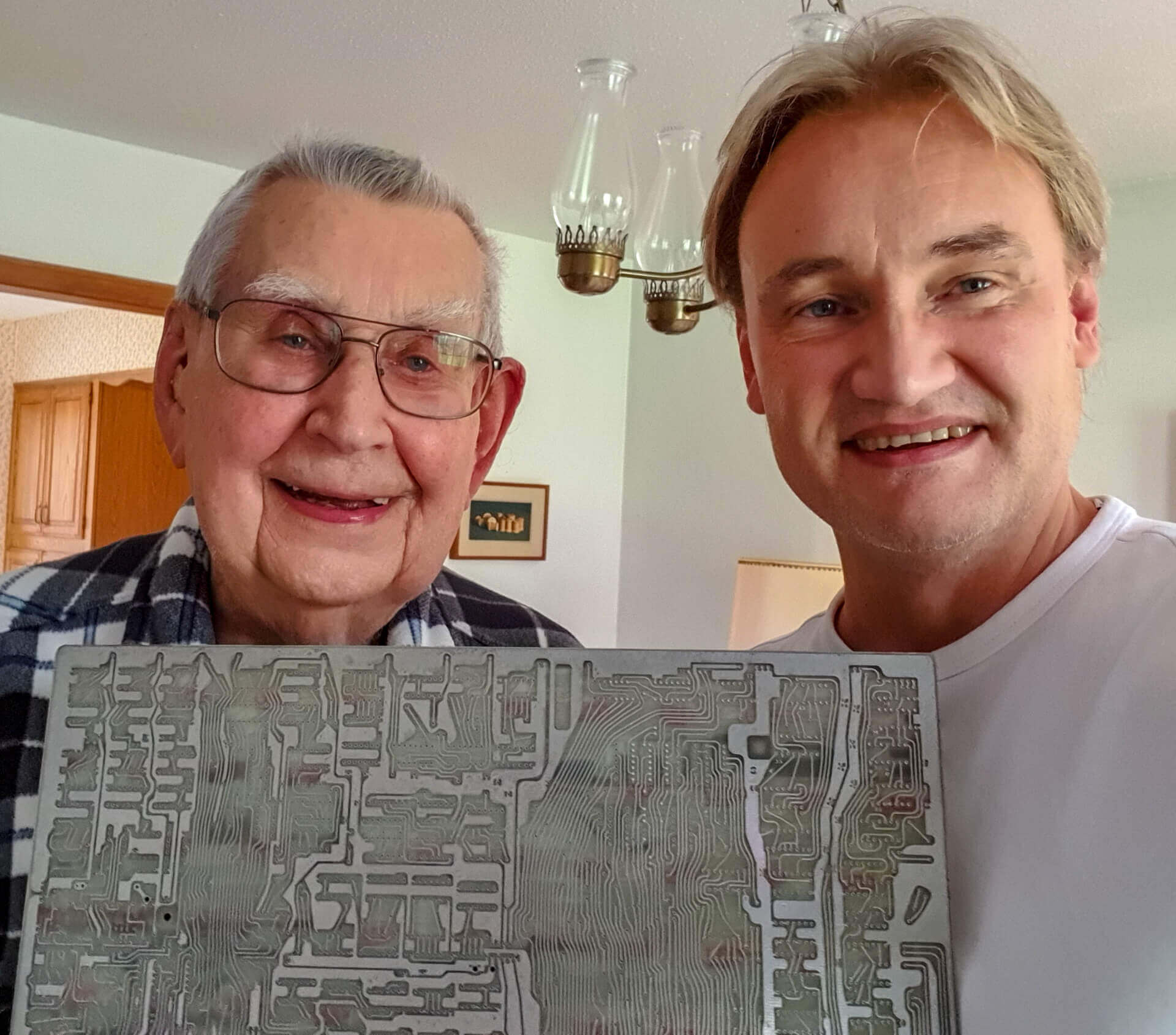 +
John Blankenbaker and me 2019
+
John Blankenbaker and me 2019
 +
Bare PCB of the Kenbak-1
+
Bare PCB of the Kenbak-1
Any form of reprint or reproduction (including excerpts) only with written permission.
Footage
Wanted / Contact
I preserve vintage computers and related documents, and I have even given rare items to museums. If you have a vintage computer or related items to offer, feel free to contact me. Everything from mainframes to microcomputers made prior to 1984 is interesting to me.
E-Mail
Links
John Blankenbaker's website (rescued and preserved with permission of John Blankenbaker)Kenbak-1 emulator
About me
My name is Achim Baqué and I am a vintage computer collector. My mission is to preserve historically important vintage computers.
Private websiteThe Kenbak-1 Registry
Apple-1 collection
The Apple-1 Registry